
What Does 1 Chronicles 16:20 Mean?
They went from nation to nation, and from one kingdom to another people.
Key words are shown with the Hebrew or Greek and what each word meant.
Selah Decoded Version The Selah Decoded Version renders what the Hebrew and Greek words meant to the people who first heard them.
King James wording
King James Version
And when they went from nation to nation, and from one kingdom to another people;THE KEY
The Hebrew says they walked about from people to people: passage, not settlement, is the shape of this life.
THE MEANING
Your life can pass through more than one nation, governing order, and community. The verse names movement as an unfolding path, not a final arrival.
THE ROOT
וַיִּתְהַלְּכוּ
vayithallekhu
GROWS FROM
הלך
Walk, go, proceed.
This form of הלך (halak, “walk, go”) can carry the sense of walking about. English “went” hides the walking image and the sense of a way unfolding across places.
ALSO GROWS
lekh: Go; walk.
לֵךְ
This command form uses the same root, showing that the passage’s movement is part of a wider language of going forth.
holekh: One who goes; a walker.
הוֹלֵךְ
The same seed names both the movement and the one who moves, keeping the person joined to the path.
מַמְלָכָה
mamlakhah
GROWS FROM
מלך
Reign; be king.
מַמְלָכָה (mamlakhah, “kingdom”) grows from the root for reigning, so the word carries the sense of an order under rule as well as a territory. The route crosses changing structures of rule and then reaches another people.
ALSO GROWS
melekh: King.
מֶלֶךְ
The ruler and the kingdom share the same root, linking the place crossed with the authority that shapes it.
malakh: To reign; to rule.
מָלַךְ
This verb exposes the action inside “kingdom”: it is a realm organized around reigning.
אַחֵר
aḥer
GROWS FROM
אחר
Be behind or after; what follows, hence another or different.
“another people” in this verse is aḥer. אַחֵר (aḥer, “another”) belongs to a root also used for “after.” It marks difference while echoing the sequence of the verse: one people follows another along the path.
ALSO GROWS
aḥarei: After; behind.
אַחֲרֵי
This branch makes the root’s sense of following audible in the movement from one people to the next.
aḥaron: Last; latter.
אַחֲרוֹן
It extends the same after-sense toward what comes later in a sequence.
THE PATTERN
A life can pass through multiple places and peoples without any one border being its final measure.
And behold, I am with you, and I will guard you in every place you go, and I will bring you back into this land; for I will not leave you until I have done the word I have spoken to you.In self-commitment all these died, not having received the promises, but seeing them from far off, and embracing them, and confessing that they were strangers and those passing through on the earth.Beloved, I urge you as those dwelling alongside and those far from home, to hold yourselves away from the fleshly cravings, which march against your soul.THE THREAD
And the LORD said to Abram, Go away from your land, from your land of birth, and from your father's house, to the land I will let you see.“Get thee out” translates לֶךְ־לְךָ (lekh-lekha, “go for yourself”), built from the same הלך (halak, “walk, go”) root as “went” here. The shared verb ties leaving one familiar setting to moving onward through successive peoples.
Read the SDV Bible.
Every verse has a Deep Dive in the app.
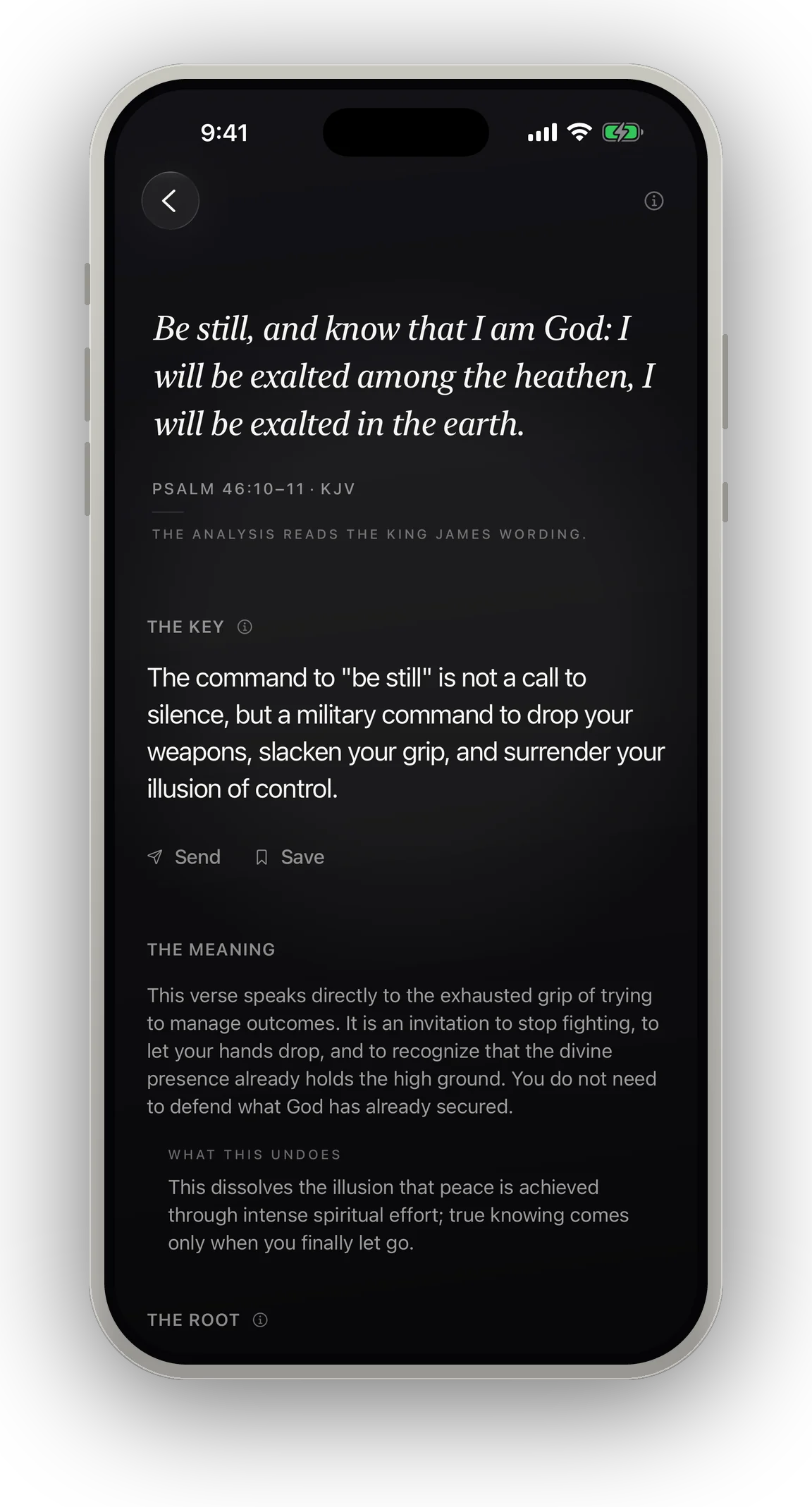
The iPhone Bible app with the Selah Decoded Version.
Does something in this reading look wrong? Tell us