What Does Matthew 21:21 Mean?
Jesus answered and said to them, Truly, I say to you, If you have self-commitment and do not doubt, you will not only do what was done to the fig tree, but also, if you say to this mountain, Be lifted away and be cast into the sea; it will come to pass.
Key words are shown with the Hebrew or Greek and what each word meant.
Ἀποκριθεὶς δὲ ὁ Ἰησοῦς εἶπεν αὐτοῖς· ἀμὴν λέγω ὑμῖν· ἐὰν ἔχητε πίστιν καὶ μὴ διακριθῆτε, οὐ μόνον τὸ τῆς συκῆς ποιήσετε, ἀλλὰ κἂν τῷ ὄρει τούτῳ εἴπητε· ἄρθητι καὶ βλήθητι εἰς τὴν θάλασσαν, γενήσεται·
Apokritheis de ho Iesous eipen autois; amen lego humin; ean echete pistin kai me diakrithete, ou monon to tes sukes poiesete, alla kan to orei touto eipete; artheti kai bletheti eis ten thalassan, genesetai;
Greek text: Textus Receptus (Scrivener 1894). Accents and word data: STEP Bible, www.STEPBible.org, Tyndale House Cambridge (CC BY 4.0).
Selah Decoded Version The Selah Decoded Version renders what the Hebrew and Greek words meant to the people who first heard them.
King James wording
King James Version
Jesus answered and said unto them, Verily I say unto you, If ye have faith, and doubt not, ye shall not only do this which is done to the fig tree, but also if ye shall say unto this mountain, Be thou removed, and be thou cast into the sea; it shall be done.THE KEY
Jesus tells his disciples that trust which is not split in two will do more than what happened to the withered tree: a word spoken from it can send even a mountain out of its place and down into the sea.
THE MEANING
The withered tree has just shown what happens to a life that gives leaves without fruit, and now Jesus turns the disciples toward what an undivided heart can move. The mountain here is whatever rises up in you and seems as fixed as the ground: the weight you have built your days around, the thing you assume will always be there. What keeps it standing is not too little effort. It is a self that keeps sorting itself into two, half leaning in and half holding back, saying the word while watching to see if it will work. When that inner split falls away, what looked like bedrock turns out to be movable, and the sea takes it.
WHAT THIS UNDOES
This undoes the belief that the immovable things inside you are permanent ground rather than masses held in place by your own divided heart.
THE ROOT
διακρίνω
diakrínō
IN THIS VERSE
doubt
GROWS FROM
κρίνω
The root pictures separating things that have been mixed together, sorting one from another so each can be told apart.
“doubt” renders diakrino, to separate thoroughly, to keep cutting one thing into two and sorting between the halves. Here it is not honest questioning but a self that holds the spoken word on one side and the standing mountain on the other and keeps weighing them against each other. The verse asks for a trust that has not been sliced through: one piece, not two. διακρίνω (diakrínō) and διάκρισις (diákrisis) come from a single root.
ALSO GROWS
diákrisis: telling things apart, discerning
διάκρισις
Diakrisis is the gift of telling things apart, the discernment that sorts true from false. Turned inward on your own trust, that same sorting motion stops clarifying and starts dividing you against yourself.
More roots ›
πίστις
pístis
IN THIS VERSE
have self-commitment
GROWS FROM
πειθ
It pictures a person being won over by words and coming to rely on what is said.
“self-commitment” renders pistis, the settled state of having been won over and now relying on what has been spoken. It is not a strength you pump up but a place you come to rest. In the verse it is set directly against the split of diakrino: the one who rests whole is the one whose word carries.
ALSO GROWS
peíthō: persuade, trust
πείθω
Peitho is to be persuaded, to be won over until you rest on what was said. The verse’s trust is that resting, the moment the inner argument has stopped.
αἴρω
aírō
IN THIS VERSE
lifted
GROWS FROM
αἰρ-
The root pictures lifting something up from where it rests and carrying it away.
“lifted” renders airo, to raise something from where it rests and carry it off. The word pictures the mountain not as broken or worn down but as picked up whole from its seat and taken away, then hurled into the deep. What seemed rooted in the earth is shown to be liftable.
ALSO GROWS
apaírō: to lift off, remove
ἀπαίρω
Apairo is to lift off and remove, the same raising that ends in something being gone. It shows that the raising in this verse is not display but departure.
THE PATTERN
What stands immovable gives way not to greater force but to a trust that is no longer divided against itself.
And Jesus said to them, Because of your little self-commitment. For truly, I say to you, if you have self-commitment as small as a grain of mustard seed, you will say to this mountain, Move from here to there, and it will move, and nothing will be impossible for you.And the Lord said, If you had self-commitment, even as much as a grain of mustard seed, you would say to this mulberry tree, Be uprooted and be planted in the sea, and it would obey you.And not growing weak in self-commitment, he did not look at his own body, already deadened, though he was about a hundred years old, nor at the deadness of Sarah's womb.THE THREAD
James holds the same three things this verse holds: committed trust, the inner split, and the sea. He says “for the one who is divided is like a wave of the sea”, so the divided self is the one that ends up tossed in the water. In Matthew it is the mountain that goes into the sea. When the split heals, what gets thrown into the deep is the obstacle, not you.
Read the Selah Decoded Version, translated from the Hebrew and Greek.
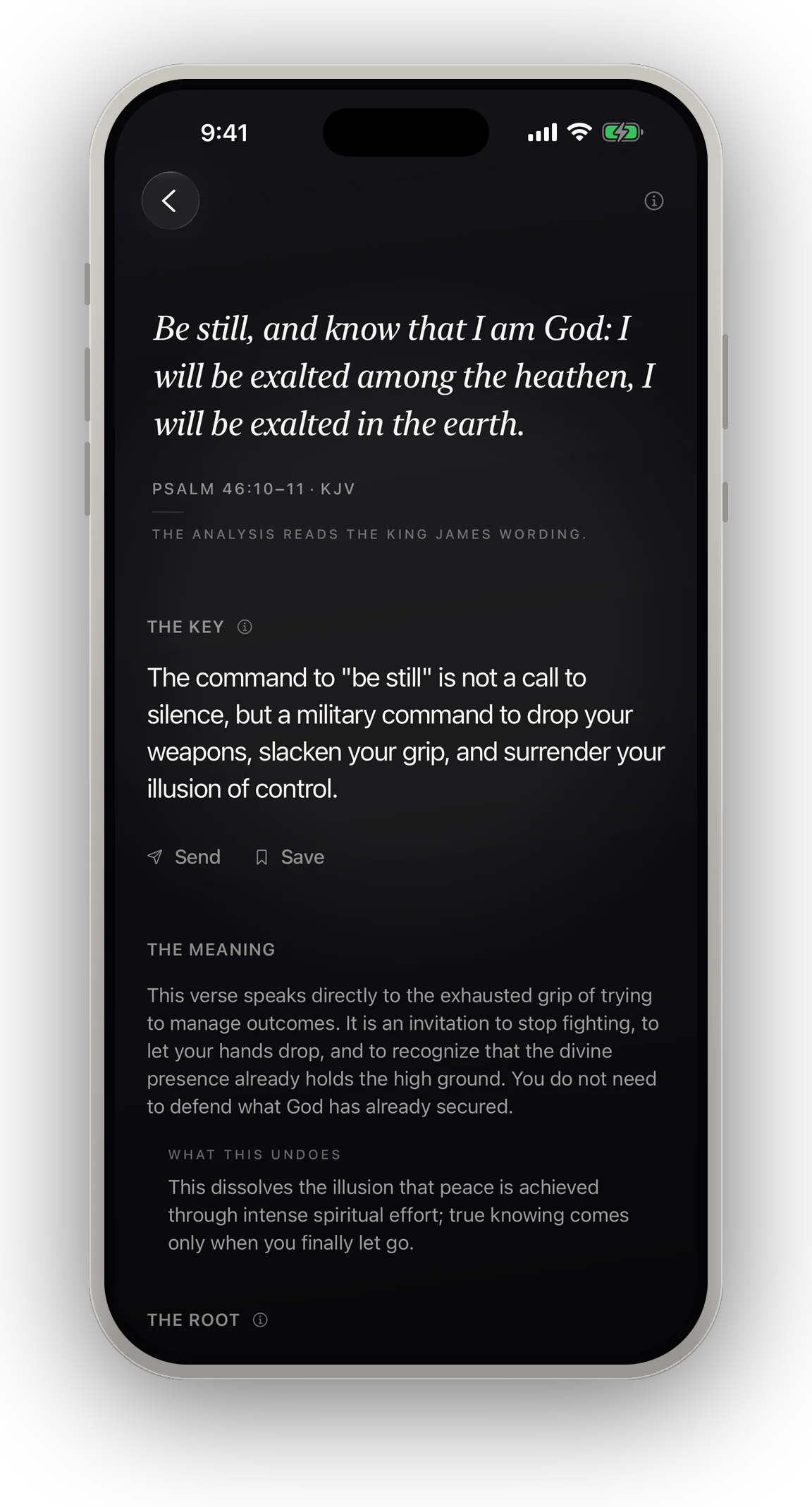
In the app, any verse can be read the way you just read this one.
Selah is an app for iPhone and Android that decodes the Bible, word by word.
Does something in this reading look wrong? Tell us