What Does Mark 11:23 Mean?
Truly, I tell you, whoever says to this mountain, Be lifted and be cast into the sea, and does not doubt in his heart, but believes that what he speaks comes to pass, he shall have whatever he says.
Key words are shown with the Hebrew or Greek and what each word meant.
ἀμὴν γὰρ λέγω ὑμῖν ὅτι ὃς ἂν εἴπῃ τῷ ὄρει τούτῳ· ἄρθητι καὶ βλήθητι εἰς τὴν θάλασσαν, καὶ μὴ διακριθῇ ἐν τῇ καρδίᾳheartG2588 αὐτοῦ ἀλλὰ πιστεύσῃ ὅτι ἃ λέγει γίνεται, ἔσται αὐτῷ ὃ ἐὰν εἴπῃ.
amen gar lego humin hoti hos an eipe to orei touto; artheti kai bletheti eis ten thalassan, kai me diakrithe en te kardia autou alla pisteuse hoti ha legei ginetai, estai auto ho ean eipe.
Greek text: Textus Receptus (Scrivener 1894). Accents and word data: STEP Bible, www.STEPBible.org, Tyndale House Cambridge (CC BY 4.0).
Selah Decoded Version The Selah Decoded Version renders what the Hebrew and Greek words meant to the people who first heard them.
King James wording
King James Version
For verily I say unto you, That whosoever shall say unto this mountain, Be thou removed, and be thou cast into the sea; and shall not doubt in his heart, but shall believe that those things which he saith shall come to pass; he shall have whatsoever he saith.THE KEY
Jesus promises that anyone who commands even the most immovable thing to go, with no split inside and with the whole self committed to God that the word is already becoming real, will receive what was spoken.
THE MEANING
Whatever stands in front of you as fixed and permanent can be addressed, and the verse hands that speech to anyone at all. The mountain does not give way to effort; the verse sets the whole matter inside the one speaking. One part of you can utter the word while another part is already ruling against it. When that inner dispute ends and your whole self is committed to God, what you say and what you receive stop being two separate things.
WHAT THIS UNDOES
This undoes the belief that an immovable thing yields only to greater strength, when the verse places the whole matter in whether the one speaking is divided within.
THE ROOT
διακρίνω
diakrínō
IN THIS VERSE
does not doubt
GROWS FROM
κρίνω
The root pictures separating things that have been mixed together, sorting one from another so each can be told apart.
Diakrino, behind “doubt”, means to separate thoroughly, pulling apart and sorting what has been mixed together. Here the verb turns inward: a person holds court against himself, one part speaking and another part ruling on whether the word can stand. The verse names no shortage of strength; it names a self that has been split into two parties. διακρίνω (diakrínō) and κρίνω (krínō) come from a single root.
ALSO GROWS
krínō: to distinguish, judge
κρίνω
Krino is the act of judging between options, and the trouble in this verse is that judging carried on inside the one who speaks.
diákrisis: telling things apart, discerning
διάκρισις
Diakrisis is the power of telling things apart, a gift when it is pointed at what stands before you; turned against your own spoken word, the sorting becomes division.
More roots ›
αἴρω
aírō
IN THIS VERSE
Be lifted
GROWS FROM
αἰρ-
The root pictures lifting something up from where it rests and carrying it away.
Airo, behind “lifted”, means to raise a thing from where it rests and carry it away. It is spoken here to the most settled feature of any landscape, and it treats that resting place as something that can be left. Nothing is climbed, tunneled or built over; what blocks the way is simply taken off.
καρδία
kardía
IN THIS VERSE
heart
GROWS FROM
καρδία
The heart is the chest organ that beats and moves blood through the body.
Kardia, behind “heart”, is the beating organ in the chest and the seat of thought and feeling. The verse places the whole contest there, in the living center of the body, rather than at the lips or out on the landscape. The mouth can be saying one thing while the kardia keeps a different count.
ALSO GROWS
sklērokardía: hardness of heart, a heart gone dry
σκληροκαρδία
Sklerokardia pictures this inner center gone hard and dry, a condition that sits close to the withered tree the passage has just shown.
THE PATTERN
What happens outwardly answers to whether the inner self stands undivided before God.
Delight yourself in the LORD, and he will give you the requests of your heart.And Jesus said to them, Because of your little self-commitment. For truly, I say to you, if you have self-commitment as small as a grain of mustard seed, you will say to this mountain, Move from here to there, and it will move, and nothing will be impossible for you.If you remain in me, and my words remain in you, ask whatever you want, and it will be done for you.THE THREAD
Jesus answered and said to them, Truly, I say to you, If you have self-commitment and do not doubt, you will not only do what was done to the fig tree, but also, if you say to this mountain, Be lifted away and be cast into the sea; it will come to pass.Here the condition arrives as “If you have self-commitment and do not doubt”, setting commitment and the undivided inner self side by side so that each explains the other. Read next to each other, the two sayings show that refusing the inner split is not a second requirement added to commitment. It is what commitment looks like from inside.
Read the Selah Decoded Version, translated from the Hebrew and Greek.
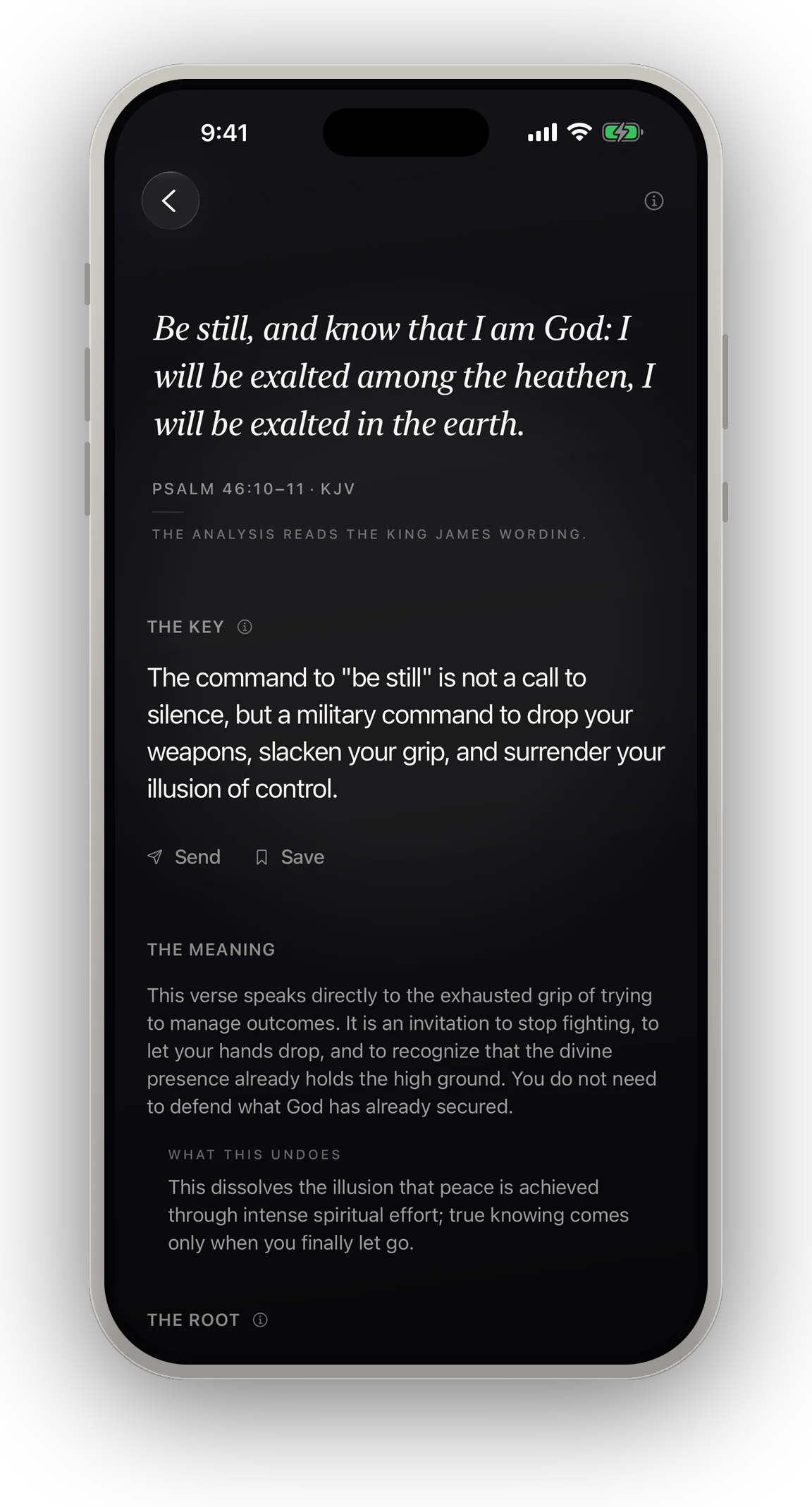
In the app, any verse can be read the way you just read this one.
Selah is an app for iPhone and Android that decodes the Bible, word by word.
Does something in this reading look wrong? Tell us